
Key Takeaways
- There is no single correct answer to "how often should I get a facial." The right frequency depends on your skin type, the specific concern you're treating, and which treatment you're getting.
- As a general guideline, most people benefit from a facial every 4–6 weeks — but oily or acne-prone skin often does better at 3–4 weeks, while dry or sensitive skin needs 6–8 weeks to avoid over-treating.
- KL's climate — air conditioning, high humidity-to-AC contrast, and a high UV index — genuinely pushes most people toward the more frequent end of these ranges compared to cooler climates.
- The treatment itself matters as much as skin type: a basic express facial tolerates more frequent visits, while energy-based treatments like Geneo X need 3–4 weeks between sessions for the skin's response to build.
- More isn't always better. Over-treating is a real, documented risk — the honest answer sometimes means recommending less frequent visits than a client expects.
If you've searched "how often should I get a facial" and landed on a page promising one clean number — every 4 weeks, every month, whatever it is — you've probably noticed it doesn't quite match what your own skin tells you. That's because the right answer isn't a marketing decision, it's a biology one: how fast your skin actually renews itself, what a given treatment does to it at a cellular level, and how much recovery time that process needs. Below is the research-grounded version, explained simply — how frequency genuinely varies by skin type, by treatment, and by living in KL specifically.
Why "Every 4 Weeks" Isn't the Right Answer for Everyone
What Actually Determines Frequency
"Every 4 weeks" gets repeated so often it's treated as fact — but it's really just an average of very different recommendations, smoothed into one round number. In practice, the right interval depends on at least three separate factors: your skin type, the specific treatment, and how your skin is actually behaving that month.
There's a biological reason a "roughly monthly" number keeps surfacing as the default: it loosely tracks the epidermis's own renewal cycle. In young, healthy skin, a cell is born in the base layer, migrates to the surface, and sheds in an average of about 28 days — though more recent measurement methods put full epidermal turnover anywhere from roughly 30 to over 40 days, and this slows further with age. That's a reasonable backdrop for general maintenance, but it says nothing about what a specific treatment does to your skin — which is where the real variation comes from.
Why this changes month to month
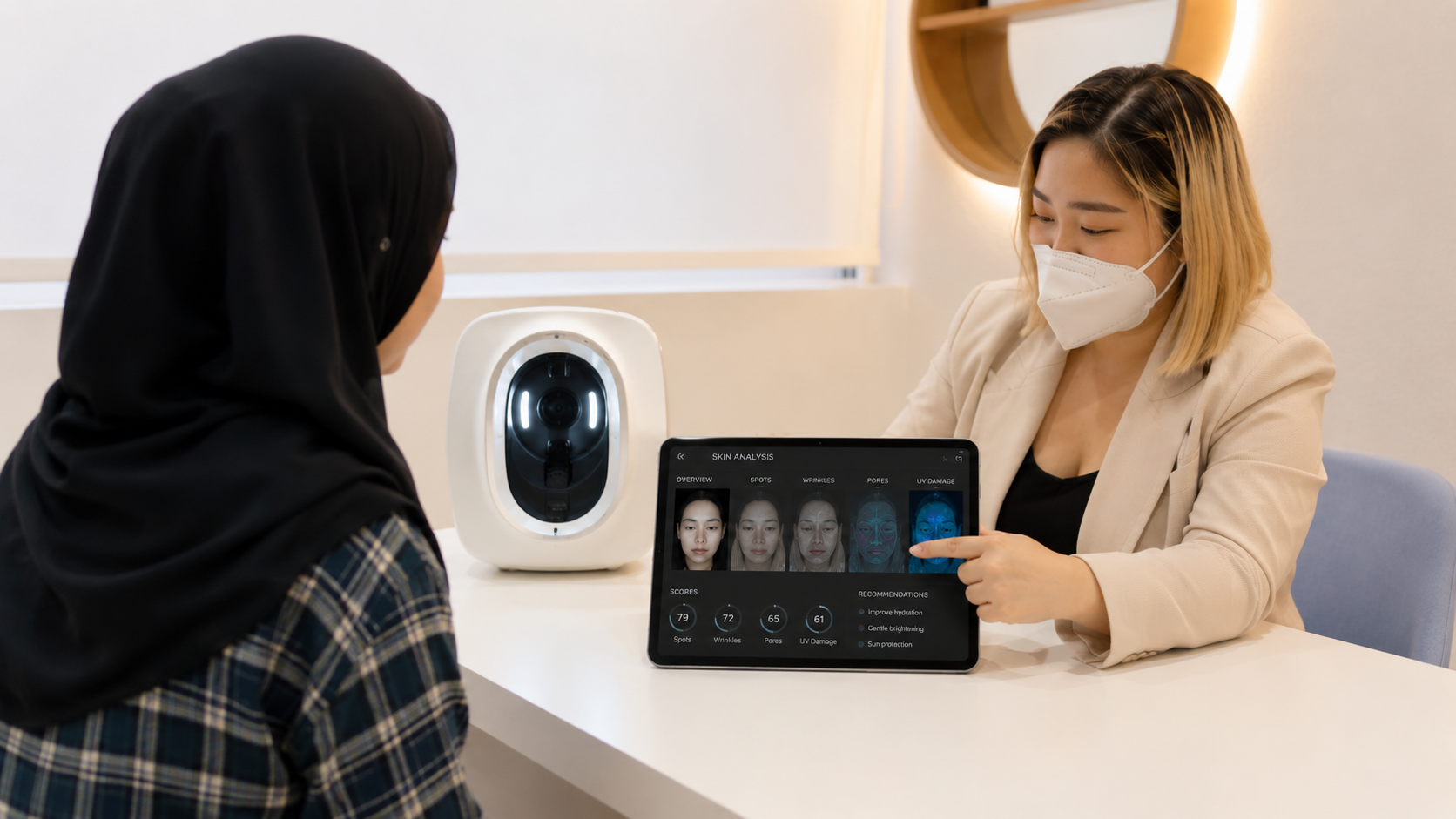
A real consultation looks at your current skin condition, not just your skin type on paper. The same person's "right frequency" can shift depending on stress, season, sun exposure, or whatever is currently happening with their skin — which is why a one-time recommendation rarely holds for a full year.
Facial Frequency by Skin Type — A Realistic Breakdown
Use These as a Starting Point, Not a Rule
Here is a genuinely honest starting range for each skin type. Treat these as something to discuss at consultation, not a fixed prescription.
Oily / Acne-Prone Skin
More frequent sessions help manage ongoing congestion and oil regulation, but over-treating can trigger irritation that worsens breakouts. Balance is key.
Dry / Sensitive Skin
Less frequent treatment avoids over-stripping an already fragile barrier. Hydration-focused formulas matter more here than frequency.
Combination Skin
Sits between the two extremes — frequency often needs to flex seasonally as the T-zone and cheek areas behave differently across the year.
Mature / Ageing-Concern Skin
More frequent sessions support the cumulative collagen-building effect of RF and energy-based treatments — consistency matters more than any single session.
Why this matters more here than elsewhere
Oily and acne-prone skin isn't a minority concern in Malaysia. A dermatology-led study of high school and university students in Sarawak found an overall acne vulgaris prevalence of 75.8%, rising to 85.5% in the 16–18 age group. If your skin feels oilier than you'd like, the research suggests you're in the majority, not the exception — which is also why "oily/acne-prone" sits at the more frequent end of these ranges rather than being treated as an outlier case.
Facial Frequency by Age Group
Your Skin's Renewal Speed Changes With Age
Age changes the calculation too — and not just because concerns shift from acne to pigmentation to laxity. The epidermal turnover cycle itself slows down as you get older, which changes how much recovery time a treatment actually needs between sessions.
| Age Group | Skin Renewal Cycle | Common Concern | Recommended Frequency |
|---|---|---|---|
| Teens & 20s | ~28 days (fastest) | Oil & acne control | Every 3–4 weeks |
| 30s | ~30–35 days | Combination skin, early dehydration, first fine lines | Every 4–5 weeks |
| 40s | ~35–40 days | Pigmentation/melasma, early laxity | Every 3–4 weeks (course-based) |
| 50s & beyond | 40–60 days (slowest) | Slower healing, deeper laxity, drier barrier | Every 5–6 weeks |
The pattern holds up against epidermal turnover research: younger skin renews fast enough to tolerate more frequent treatment, while skin in its 40s and beyond needs longer windows to complete its repair cycle between sessions. The two concerns flagged in the table are backed by real Malaysian and regional data — acne peaks in the late teens before easing with age, while melasma affects as much as 40% of women in Southeast Asian populations, Malaysia included, typically becoming more noticeable from the 30s onward.
Age is a starting point, not a verdict
These ranges describe averages, not individuals — skin condition, sun exposure history, and treatment history all shift where you actually land. A 45-year-old with well-maintained skin may behave more like the 30s row; a 28-year-old with chronic barrier damage may need to treat more like the 40s row. That's exactly what a consultation is for.
It Also Depends on the Treatment Itself
Different Treatments, Different Timelines
Skin type alone doesn't determine frequency — the treatment matters just as much. A gentle express facial and an energy-based treatment like Geneo X work on completely different timelines because they're doing different things to the skin.
| Treatment | Recommended Frequency | Why | Approx. Price (KL) |
|---|---|---|---|
| Basic / express facial | Every 2 weeks | Minimal active ingredients, low barrier disruption — tolerates more frequent visits | RM80–RM250 |
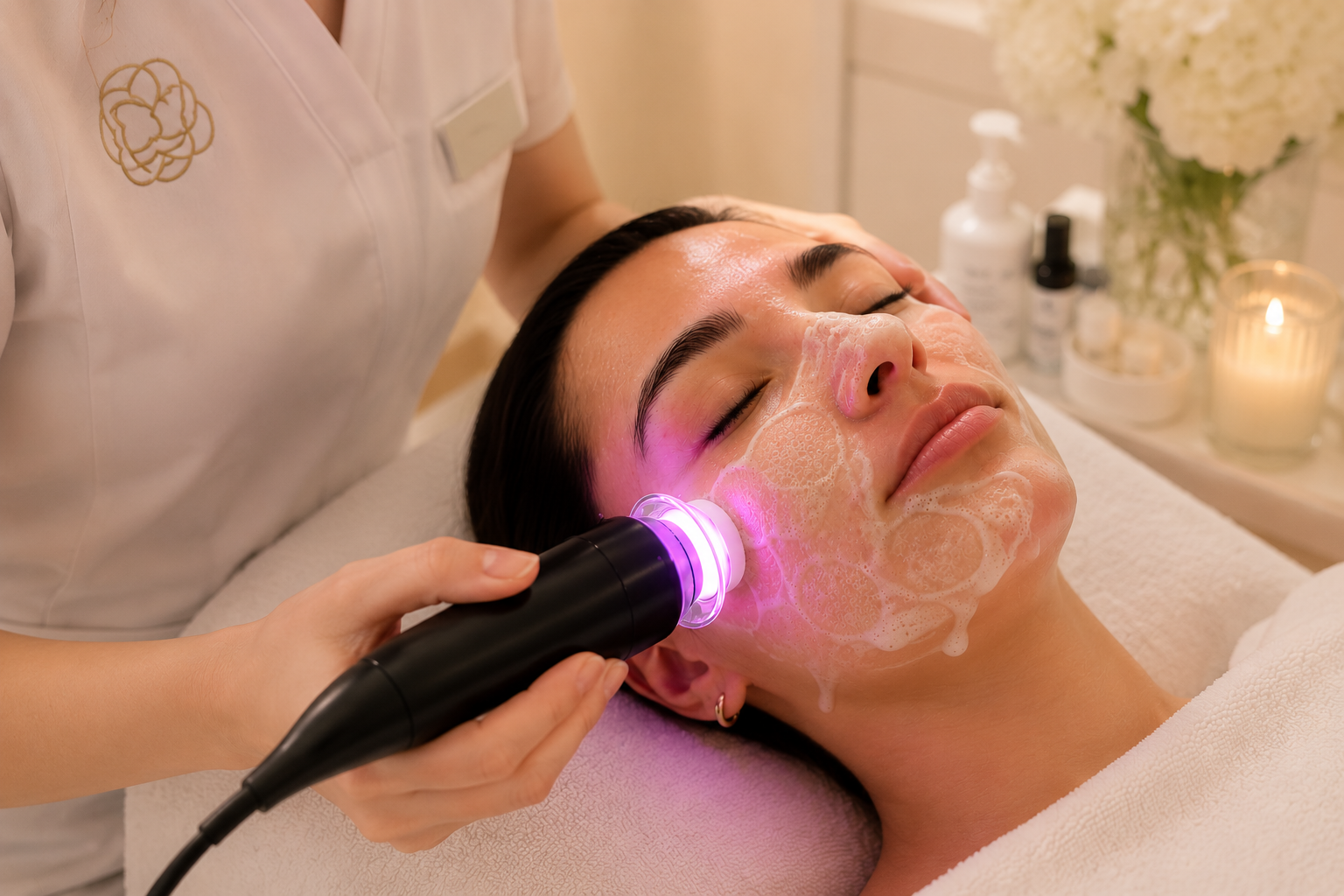
| Geneo X — Casablanca | Every 3–4 weeks | RF and cellular activation need this window for the collagen response to build between sessions | From RM399 |
| Hydration / infusion facial | Every 4 weeks | Matches the skin's natural moisture turnover cycle | RM399–RM700 |
| Chemical peel | Every 4–6+ weeks | Deeper exfoliation needs longer recovery before the next session | RM200–RM450 |
This is where Geneo X's "every 3–4 weeks" guidance sits on solid ground rather than house preference. Its RF component works through a process dermatologists call neocollagenesis: controlled heat signals fibroblasts — the cells that manufacture collagen — to ramp up production. A clinical review of radiofrequency skin-tightening devices describes this collagen-rebuilding response beginning roughly four to six weeks after treatment and continuing for months afterward. Treating again before that window opens doesn't speed the biology up — it just adds another round of mild thermal stress on top of a process that's still mid-build.
In short
A basic express facial can be done more frequently with low risk. An energy-based treatment like Geneo X is typically recommended every 3–4 weeks. A more aggressive peel may only be appropriate every 4–6 weeks or longer.
KL's Climate Factor: Why You May Need More Than the "Global Average"
A Different Kind of Stress on the Skin
Most facial-frequency guidelines are written for temperate climates. KL isn't one. Between near-constant air conditioning indoors, high outdoor humidity, and a consistently high UV index, skin here is under a different kind of stress than the guidelines assume.
That AC-to-humidity swing dehydrates skin faster than a stable climate would, while the UV load accelerates barrier stress and pigmentation risk. KL's combination of high UV index, humidity-to-air-conditioning contrast, and pollution exposure accelerates skin dehydration and barrier stress compared to more temperate climates.
There's a specific mechanism behind one of the more confusing patterns we see at consultation: skin that's oily on the surface but tight and dehydrated underneath. A clinical study on humidity and skin characteristics found that low-humidity air — the kind air conditioning produces — measurably increases sebum output as the skin tries to compensate for moisture it's losing, even as overall hydration drops. In other words, hours in an air-conditioned office can leave your skin both oilier and more dehydrated at the same time, which is exactly the combination many KL clients describe.
What this means for your schedule
Many people in KL genuinely benefit from facials slightly more frequently than international guidelines suggest — particularly hydration-focused treatments — though the actual right frequency still comes back to your individual skin type and concern.
Single Sessions vs a Course — What Actually Changes Your Skin
A Typical Course-to-Maintenance Schedule
If you're treating a specific concern — pigmentation, dehydration, early fine lines — a single session rarely tells the full story. Most visible change comes from a course, where each session builds on the last.
- Week 1 — Session 1: Consultation, skin assessment, and first treatment. Sets the baseline.
- Weeks 4, 7, 10 — Sessions 2–4: Course sessions spaced 3–4 weeks apart, allowing the skin's response to build between visits.
- Week 13 onward — Sessions 5–6: Final course sessions, then reassessment of whether the concern has resolved or needs an extended course.
- Ongoing — Maintenance: One session every 4–6 weeks to sustain results, adjusted seasonally and by skin condition at each visit.
Single sessions still have a place — for general upkeep once a course has done its job, or for pre-event glow — but they shouldn't be the default plan for a concern that needs sustained treatment to actually shift.
🗓 Not sure what your skin actually needs right now? A real consultation, not a guess.
Ask on WhatsAppThe Risk of Over-Treating — The Part Most Clinics Don't Mention
Why More Isn't Always Better
It works against a clinic's short-term interest to say this, but it's the honest answer: more sessions aren't automatically better. Facials disrupt the skin barrier slightly each time, even gentle ones. Without enough recovery time between visits, that disruption compounds — showing up as sensitivity, redness, breakouts, or a barrier that's working harder to repair itself than to actually improve.
There's a measurable way to see this happening. Dermatology researchers track skin barrier health using a metric called transepidermal water loss (TEWL) — essentially, how much water escapes through the skin when its outer barrier, the stratum corneum, isn't sealing properly. TEWL is one of the standard measurements clinicians use to assess barrier dysfunction, and it rises whenever that barrier is disrupted — exactly what frequent exfoliation or active-ingredient treatments do. In plain terms: your skin has a built-in early-warning signal for over-treatment, and the tightness, sensitivity, and reactivity below are it.
Signs you may be over-treating
Increased redness or sensitivity that lingers between sessions, breakouts appearing where they didn't before, skin that feels tighter or more reactive than usual, or no further visible improvement despite more frequent visits. If any of these sound familiar, the right move is usually to space sessions out — not add more.
Most skin types need at least 3–4 weeks between sessions to fully benefit from the treatment cycle. If a clinic is recommending weekly visits without a clear medical reason, that's worth a second opinion.
How Casablanca Actually Decides Your Frequency
Consultation First, Schedule Second
We don't assign a fixed schedule before seeing your skin. Every visit starts with a real consultation — current condition, what's changed since your last visit, and what you're trying to address — and the frequency recommendation comes out of that, not the other way around. For clients on a Geneo X course, that usually means sessions every 3–4 weeks until the concern is addressed, then a conversation about whether monthly or six-weekly maintenance makes more sense for your skin going forward.
See It in Practice
Rather than a quote about how we approach consultations, here's what an actual Geneo X session at Casablanca looks like — featured by @yongjiayjp, who came in for a session and shared the experience on her Instagram.
Frequently Asked Questions
How often should you get a facial in KL?
There is no single answer that applies to everyone. For general maintenance, every 4–6 weeks aligns with the skin's natural renewal cycle. For acne-prone or oily skin, every 3–4 weeks may help manage congestion. For dry or sensitive skin, every 6–8 weeks is often enough to avoid over-treating. KL's climate — air conditioning, humidity, and high UV exposure — tends to push most people toward the more frequent end of these ranges.
Is it bad to get a facial too often?
Yes, over-treating is a real risk. Facials, especially those involving exfoliation or active ingredients, disrupt the skin barrier slightly each time. If sessions are too frequent without adequate recovery time, this can lead to sensitivity, irritation, or a compromised barrier rather than improved skin. Most skin types need at least 3–4 weeks between sessions to fully benefit from the treatment cycle.
Does facial frequency depend on the type of treatment?
Yes, significantly. A basic express facial with minimal active ingredients can be done more frequently, even every 2 weeks, with low risk. An energy-based treatment like Geneo X, which includes RF and cellular activation, is typically recommended every 3–4 weeks to allow the skin's collagen response to develop between sessions. A more aggressive chemical peel may only be appropriate every 4–6 weeks or longer.
How does KL's climate affect how often I should get a facial?
KL's combination of high UV index, humidity-to-air-conditioning contrast, and pollution exposure accelerates skin dehydration and barrier stress compared to more temperate climates. This means many people in KL benefit from facials slightly more frequently than general international guidelines suggest, particularly for hydration-focused treatments, though the actual frequency still depends on individual skin type and concern.
Should I get a facial before a course of treatments or just single sessions?
For a specific concern such as pigmentation, dehydration, or early signs of ageing, a course of 4 to 6 sessions spaced 3 to 4 weeks apart typically produces more meaningful, lasting results than isolated single sessions. Single sessions work well for general maintenance or pre-event glow once a course has established a baseline improvement.
How often should I get a Geneo X facial specifically?
If you're addressing a specific concern, we typically recommend a course of 4 to 6 sessions, spaced 3 to 4 weeks apart, to allow the RF and cellular activation effects to build. Once that course is complete, most clients move to a maintenance rhythm of one session every 4 to 6 weeks. Your therapist will confirm the right starting point at your consultation based on your skin's actual condition that day.
Does facial frequency need to change as I get older?
Yes. Skin's natural renewal cycle slows from around 28 days in your 20s to 40–60 days by your 50s, so older skin generally needs more recovery time between sessions — roughly every 5–6 weeks versus every 3–4 weeks in your 20s. The main exception is the 40s, when many people are managing pigmentation or early laxity with a course-based treatment like Geneo X, which still calls for a tighter 3–4 week interval during the active course.
Find Your Actual Frequency
Not a Generic Number — Your Skin's Number
Start with a real skin consultation. We'll assess your skin's current condition and recommend a schedule that fits it — not a one-size-fits-all rule.
Book a Consultation on WhatsAppGeneo X first-trial RM399 Skin assessment included KL & Petaling Jaya
This article was written by the team at Casablanca Aesthetic based on clinical knowledge and client consultation experience. It is intended as an educational guide and does not constitute medical advice. Individual results and suitable frequency vary by skin condition; always consult a qualified therapist before starting or adjusting a treatment schedule. Last updated: June 2026.